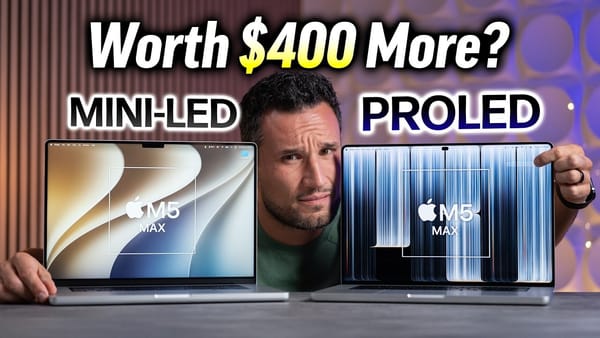
The screen was Max Tech's main reason for retiring the 16-inch M1 Max MacBook Pro it had used for five years, and the M5 Pro model with the PROLED XDR display ends the gray halos that used to ring every menu bar icon. The surprise is speed. Stepping down from a Max chip to a Pro, the new laptop still wins every test but two, which puts numbers on the OLED MacBook Pro upgrade case for M1 owners.
Six results, per Max Tech
| Test | M5 Pro | M1 Max |
|---|---|---|
| Blender, Party Tug render | 28 s | 1 min 18 s |
| Xcode build benchmark | 84.5 s | 202.9 s |
| Cinebench 2026, 10-minute multi-core | 9,304 | 3,359 |
| Lightroom Classic, 50 raw exports | 18 s | 51 s |
| Llama 3.1 8B, token generation | 58.3 tokens/s | 66.3 tokens/s |
| Final Cut Pro, 5-minute HEVC export | 1 min 42 s | 1 min 9 s |
What changes before a benchmark runs
- Weight. 4.8 lb on the M1 Max and 4.0 lb on the M5 Pro, in a 16-inch body that's shorter and sits lower on recessed feet.
- Brightness. 1,000 nits for everyday content against 500 on the old panel, and 2,000 nits for HDR against 1,600.
- Motion. Both screens run at 120Hz, but in Max Tech's UFO test the OLED keeps the shape crisp where the mini-LED smears it.
- Notch and touch. A Dynamic Island replaces the notch, and the touchscreen Max Tech expected to switch off turned out handy for browsing YouTube.
- Ports and camera. The port layout is unchanged but now runs Thunderbolt 5, and the Center Stage webcam follows a second person into the frame.
Where the speed shows up
- Single-core. Geekbench 7 runs 66% higher, with the peak clock up from 3.22 GHz to 4.61 GHz.
- Multi-core. Eighteen CPU cores against ten put the M5 Pro 2.3 times ahead, past 33,000 points.
- Graphics. With 20 GPU cores to the M1 Max's 32, the M5 Pro still scores 21% higher in the Geekbench 7 Metal test and averages 72.9 fps to 52.3 in 3DMark Steel Nomad Light.
- Storage. The 1 TB SSD reads at more than twice the old drive's speed in PulzeMark.
- Music. Logic Pro plays 365 tracks before overloading, against 210. An M4 Max managed 405, more than the M5 Max, which Max Tech blames on Apple halving the performance cores in favor of new mid cores.
Two results go the other way, and both come from hardware a Max chip has more of.
What to know
- Video export. The 33-second Final Cut Pro loss comes down to encoders: the M1 Max has two, the M5 Pro one. An 8K RED RAW export still goes to the M5 Pro, 1 min 4 s to 1 min 35 s.
- Local AI. Max Tech puts the M1 Max's faster token generation down to its greater memory bandwidth. The M5 Pro is still quicker on the prompt and the first token.
- Fans. A 10-minute Cinebench run pushes the M5 Pro's fans past half speed within about a minute, while the M1 Max's sit at their 1,500 rpm idle. The keyboard stays cooler, 40°C to 44°C, but the exhaust out the back reaches 50°C, against 45°C on the M1 Max.
Max Tech's verdict is to buy the 16-inch M5 Pro and skip the M5 Max. I'd carve out the buyers its own two losses describe: daily video exports and local models are what a Max chip's extra encoders and bandwidth are for.