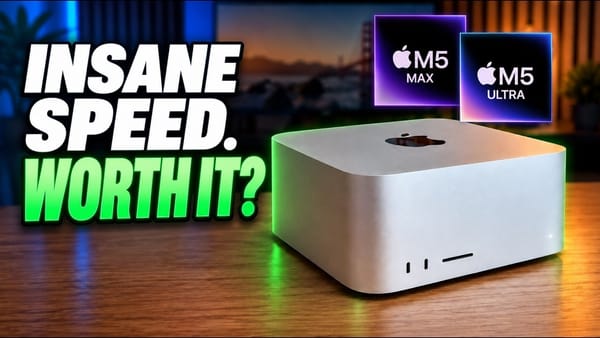
NVIDIA's RTX Spark chip puts a Blackwell GPU and up to 128 GB of unified memory inside Microsoft's Surface Laptop Ultra, the same shared-memory layout Apple silicon is built on. Matt Talks Tech lines it up against the 16-inch MacBook Pro with M5 Pro before either machine has a benchmark to show, so the comparison runs on spec sheets and on what Microsoft left unsaid.
Base models, per the video
| Spec | Surface Laptop Ultra | MacBook Pro M5 Pro, 16-inch |
|---|---|---|
| Memory | 24 GB | 24 GB |
| Storage | 512 GB | 1 TB |
| Storage upgrades | Replaceable NVMe SSD, up to 4 TB | None after purchase |
| Operating system | Windows 11 on Arm | macOS |
What the Surface brings
- Display. The 15-inch PixelSense panel runs close to 4K at 120Hz, and the video can't say yet what panel technology sits behind it.
- Ports and charging. It has HDMI, an SD card slot, USB4 on every USB port, and a magnetic USB-C charger that snaps on the way MagSafe does.
- CUDA cores. The GPU carries 5,120 or 6,144 of them alongside an 18-core or 20-core CPU, and estimates the video cites put it near an RTX 5070 or 5070 Ti.
- App support. DaVinci Resolve, Premiere Pro, Photoshop, and Blender already lean on CUDA, which is the local AI and creative pitch Microsoft is making.
- Battery claims. Microsoft quotes up to 15 hours of video playback and 18 hours of web browsing, as the video relays it, with fans inside to keep the chip cool.
Core counts settle nothing. The video says so plainly: add CUDA cores and the Surface pulls ahead of an M5 Pro; swap in an M5 Max against a smaller configuration and the Mac wins. The two GPUs use their cores so differently that Matt Talks Tech refuses the straight comparison.
It literally is a comparison of apple to bananas here.
What the video can't answer yet
- GPU memory cap. macOS can hand more than 100 GB of a 128 GB pool to the GPU and take it back afterward. RTX Spark caps the GPU's share by memory tier, and nobody has said where the line sits.
- Bandwidth. Microsoft's figure measures the link between CPU and GPU, not the memory bandwidth Apple quotes at its keynotes, so the two numbers don't line up.
- Unplugged speed. A MacBook Pro runs at full performance on battery. Windows laptops with dedicated GPUs often throttle hard when unplugged, the video notes, and RTX Spark hasn't been tested either way.
- Windows 11 on Arm. x86 apps still go through Prism translation, which developers have had mixed luck with, per the video, and day-one Linux support isn't confirmed.
Matt Talks Tech stays on macOS for the way the iPhone, AirPods, and Mac work together. My own read is that the replaceable SSD is the one Surface advantage that holds before any benchmark, and Apple went the other way when the M6 Mac mini soldered its SSD.