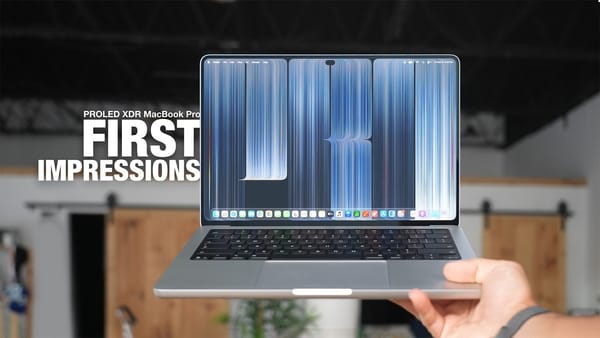
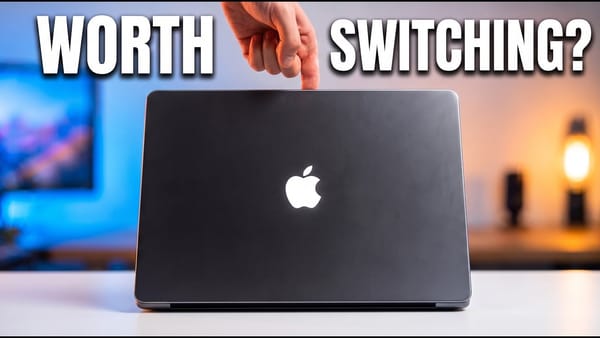
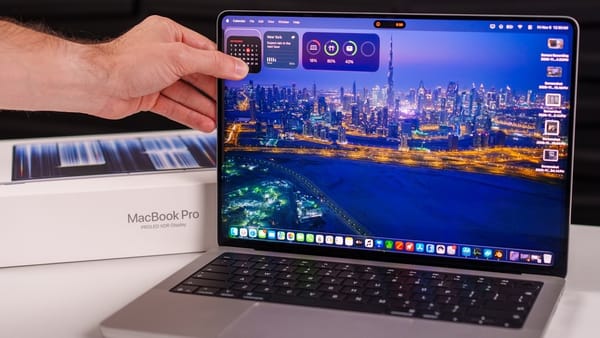
I'd want a full battery rundown before treating this as an endurance upgrade. Matt Talks Tech compares OLED and mini-LED MacBook Pros with matching M5 Max chips, 128GB of memory, and 4TB SSDs, finding little speed difference across its tests. The battery result is more interesting, but narrower than the video's conclusion.
The machines swap small leads. In Matt Talks Tech's DaVinci Resolve export, the OLED model takes 33 seconds against 31 for mini-LED; an 8K RAW timeline render goes the other way, at 39 seconds against 41. Lightroom and local AI workloads follow the same near-tie pattern, while Cyberpunk 2077 averages 85fps on OLED and 87fps on mini-LED at the stated Ultra preset. After a sustained Cinebench GPU load, the thermal-camera readings differ by less than a degree Celsius. For iPhoners buying around export speed, these results give the display redesign little weight in the decision.
Battery remaining is a different measurement from battery life. The video reports 39% left on OLED and 34% on mini-LED after the test sequence, then estimates what the gap might become when the older display model runs flat. It doesn't show that endpoint.
I wouldn't turn those five percentage points into a confirmed runtime gain, or assume the panel alone caused them.