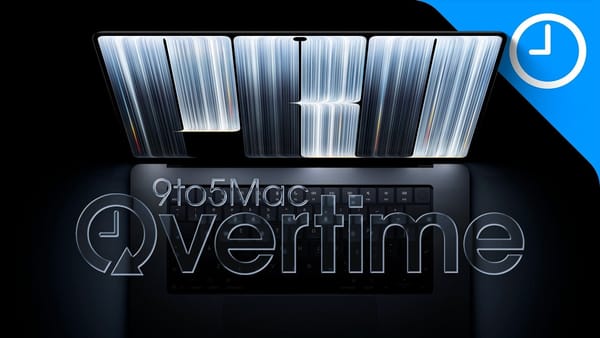
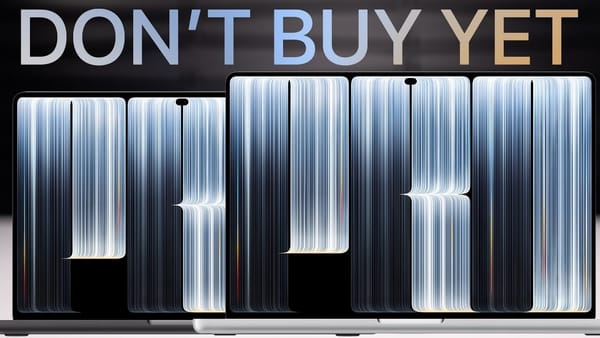
Five years after the last MacBook Pro redesign, the new PROLED XDR model and the mini-LED Liquid Retina XDR model now sell side by side with the same M5 Pro and M5 Max chips. Matt Talks Tech went through Apple's spec sheets to find what actually separates them, and almost all of it is the screen and the body, with the chips and memory options left exactly where they were.
Apple's numbers, side by side
| Spec | PROLED XDR | Liquid Retina XDR |
|---|---|---|
| Contrast | 10,000,000:1 | 1,000,000:1 |
| HDR peak | 2,000 nits | 1,600 nits |
| Outdoor SDR | 2,000 nits | 1,000 nits |
| 14-inch weight, M5 Pro | 3.0 lb | 3.5 lb |
| 16-inch thickness | 1.60 cm | 1.68 cm |
The OLED is a tandem panel with two self-emitting layers, and its pixels switch off one by one, so there's no blooming around bright objects on black. ProMotion now drops as low as 10Hz, and Adobe RGB joins P3. The 16-inch screen picks up a little resolution, 3,472 by 2,266 at the same 254 pixels per inch. Around the edges sit three Thunderbolt 5 ports at up to 120Gb/s, plus HDMI, SDXC, MagSafe 3, and a headphone jack.
What the spec sheet can't settle yet
- Thermals. Apple says the cooling was redesigned to sustain M5 Pro and M5 Max speeds in a lighter chassis, but it publishes no fan noise or temperature figures. Airflow through the hinge comes from press reports, and Apple's page doesn't confirm it.
- Battery. Apple claims up to 22 hours of video on the 14-inch M5 Pro and 24 on the 16-inch, from its own tests rather than measurements.
- Fast charging. Getting to 50 percent in 30 minutes needs a 96W adapter on the 14-inch and 140W on the 16-inch.
- Reference modes. The list now covers video, photography, print, and DICOM medical review, so color and imaging work is the target.
The channel's own caveat is the right one: reflections and real HDR scenes need a hands-on look. For anyone who edits in a dark room, though, the contrast row is already the whole decision.